


Why the Mavic 4 Pro Exists
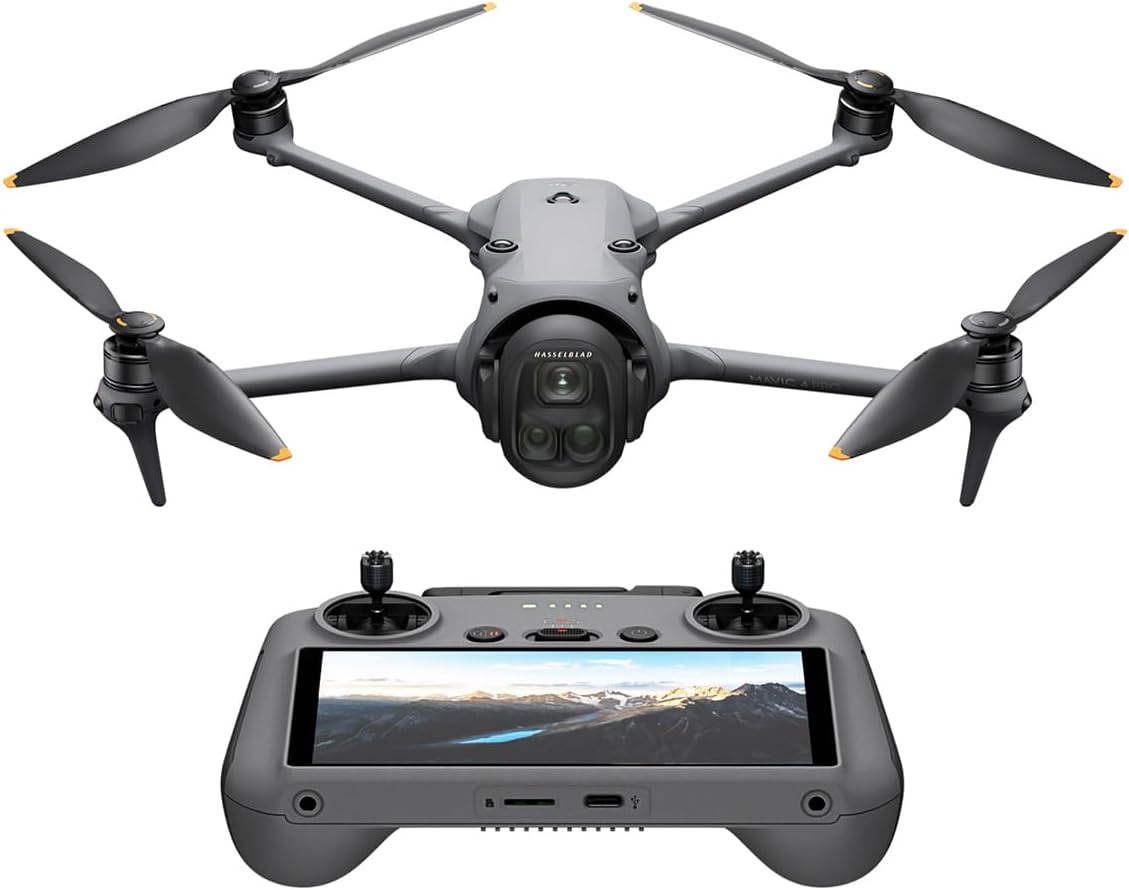
DJI’s Mavic line has always been the company’s flagship: the drone you buy when image quality matters more than anything else. The Mavic 4 Pro takes that position further than ever. Instead of one camera, it carries three — a 100MP Hasselblad main camera plus two large-sensor telephoto cameras — on a gimbal that can rotate a full 360 degrees. DJI lists a maximum flight time of up to 51 minutes.
This is not a casual purchase. It is a heavy, registration-required, pro-tier flying camera that sits in the $2,000+ class (Tom’s Guide lists launch pricing from $2,699 / £1,879, varying by combo and market). If you are deciding whether it deserves that money, here is what the hardware actually gives you, who it is really for, and who should save their money.
The Tri-Camera System, in Plain English
The headline is three cameras with three real optical focal lengths. That matters because optical focal lengths give you genuine perspective compression and detail that digital zoom cannot fake.
Main camera — 28mm equivalent, 100MP 4/3-inch CMOS Hasselblad. This is the workhorse: 6K/60fps HDR video, up to 16 stops of dynamic range, Hasselblad Natural Color Solution, and an adjustable aperture from f/2 to f/11. The 4/3-inch sensor is the same class found in mirrorless cameras, and the adjustable aperture means you can control depth of field and shoot properly in bright conditions without stacking on ND filters for basic exposure control.
Medium telephoto — 70mm equivalent, 48MP 1/1.3-inch CMOS. The 70mm is the perspective storyteller: compressed backgrounds, flattering real-estate orbits, detail shots of buildings and infrastructure from a respectful distance. It records 4K/60fps HDR with 14 stops of dynamic range.
Telephoto — 168mm equivalent, 50MP 1/1.5-inch CMOS. The long lens. This is what lets you frame wildlife, roof inspections, or distant subjects tightly without flying close. 4K/60fps HDR, 13 stops of dynamic range, f/2.8.
In practice, the point is not just “three cameras” — it is that you can shoot a wide establishing shot, a compressed medium shot, and a tight telephoto detail without landing to change lenses, which for a drone is impossible any other way.
Video and Stills: What the Specs Mean for Your Footage
Video tops out at 6K/60fps HDR on the main camera, with 4K/120fps slow motion available for action sequences. All three cameras record 4K/60fps HDR, so cutting between focal lengths in the edit does not mean a quality cliff. True vertical shooting (4K/60) is built in for social-first work, and 10-bit D-Log, D-Log M, and HLG profiles give colorists real latitude in post.
On the stills side, 100MP files give enormous cropping and printing headroom — genuinely useful for mapping, surveying, and inspection work where pixel-level detail is the deliverable, not just a spec-sheet brag.
Storage: the standard version ships with 64GB of internal storage; the Creator Combo steps up to 512GB and supports ALL-I 4:2:2 encoding. A microSD slot (V30 or faster recommended) handles overflow on every version.
The Infinity Gimbal
This is the sleeper feature. The Mavic 4 Pro’s gimbal rotates a full 360 degrees in yaw and tilts up to 70 degrees upward — movement no previous foldable DJI gimbal could do. That unlocks shots like rotating the camera while flying a straight line, looking up at a building from below, or tracking a subject while flying laterally without yawing the whole aircraft. For cinematic work, it is the difference between flying the camera and flying the drone.
Flight Time, Range, and Obstacle Sensing
DJI rates the maximum flight time at up to 51 minutes — a lab figure measured in ideal conditions, so treat real-world flight time as meaningfully less, especially in wind or cold. It is still a huge number: fewer battery swaps per shoot, longer single-take sequences.
Transmission is DJI’s O4+ system, rated up to 30km with a 10-bit HDR feed. Real-world range is always limited by local line-of-sight rules and interference, but the link itself is the most robust DJI has shipped on a consumer drone.
Obstacle sensing is omnidirectional with six fisheye sensors rated down to 0.1 lux — DJI’s “Nightscape” sensing — meaning the drone can still detect obstacles in very low light. Note that sensing assistance is not a substitute for visual line of sight, and night-flight rules vary by country.
Who the Mavic 4 Pro Is For
- Professional filmmakers and content creators who need broadcast-usable 6K HDR, real telephoto options, and log profiles — and who bill clients enough to justify flagship hardware.
- Commercial operators doing inspections, surveying, mapping, or real-estate cinematography, where 100MP stills, adjustable aperture, and the 168mm telephoto are working tools, not toys.
- Serious enthusiasts who have outgrown a Mini or Air and want the best image quality DJI makes, and who accept the registration and weight trade-offs.
Who Should NOT Buy It
- First-time drone buyers. This is too much drone to learn on — expensive, heavy, and regulation-heavy. Start with something smaller and cheaper; this site’s guides to the DJI Mini 5 Pro and DJI Mini 4 Pro are the sane starting points.
- Casual travel and hiking shooters. At around 1,063g it is roughly four times the weight of a Mini. If your drone lives in a backpack, the weight and bulk will punish you.
- Anyone who wants minimal paperwork. See the regulation section below — this drone requires registration and pilot certification in most countries, unlike sub-249g Minis.
- Budget-conscious buyers. If the price makes you wince, a Mini-class drone delivers most of the fun and very good image quality for a fraction of the cost.
The Weight and Regulation Reality
The Mavic 4 Pro weighs about 1,063g (2.34 lbs). That single number changes everything about how you fly it legally:
- United States: FAA registration is required (it is well over the 250g threshold). Commercial work requires a Part 107 remote pilot certificate.
- Europe: it carries a C2 class label. Pilots need the online A1/A3 certificate at minimum to fly in subcategory A3, and the A2 certificate of competency to operate closer to uninvolved people.
- United Kingdom: you need a Flyer ID and an Operator ID, and you fly under the CAA’s Drone Code — with C2 rules keeping you at greater distances from people than lighter drones allow.
Compare that with a sub-249g Mini, which sits in the lightest regulatory class (C0 in the EU) with far simpler requirements. The Mavic 4 Pro’s extra capability comes with extra responsibility — factor the certification into your buying decision, not just the price. Always check your own country’s current rules before flying.
Buying Guide: Controllers and Combos
Controllers. The standard combo ships with the DJI RC 2, which has a built-in display — no phone required, no cables, no app juggling in the field. The DJI RC Pro 2 (bundled with the Creator Combo) steps up to a 7-inch rotatable Mini-LED high-brightness display that collapses for travel, with around 4 hours of controller battery life and 128GB of built-in storage. If you fly in bright sunlight or do client work, the RC Pro 2’s screen is the meaningful upgrade; if you are budget-focused, the RC 2 is fully capable.
Combos. The Fly More Combo adds extra batteries and a charging hub — worth it, because long flight times mean nothing if you are grounded waiting on a single charger. The Creator Combo goes further: 512GB of internal storage with ALL-I 4:2:2 encoding, the RC Pro 2, three batteries, and a 240W power adapter with a parallel charging hub. Buy the combo that matches your shooting volume; creators who shoot daily will outgrow the base kit fast.
A note on US availability. DJI has not launched the Mavic 4 Pro in the United States, reportedly over tariff and supply-chain issues. US buyers will find it through third-party retailers and importers — check warranty coverage carefully before buying that way, as DJI advises warranties may not apply to units bought outside official channels.
Mavic 4 Pro vs. DJI Mini 5 Pro vs. DJI Mini 4 Pro
| Mavic 4 Pro | Mini 5 Pro | Mini 4 Pro | |
|---|---|---|---|
| Camera | Tri-camera: 100MP 4/3″ Hasselblad main (28mm), 48MP 70mm tele, 50MP 168mm tele; 6K/60 HDR | Single camera; 4K video (see our Mini 5 Pro guide) | Single camera; 4K video (see our Mini 4 Pro guide) |
| Takeoff weight | ~1,063g — registration and pilot certification required | Sub-249g — lightest regulatory class | Sub-249g — lightest regulatory class |
| Best for | Pro filmmaking, inspections, mapping | Travel, everyday flying, creators who want 4K without the paperwork | Beginners and budget buyers |
| Price tier | Flagship ($2,000+ class) | Mid-range | Entry-level |
The honest summary: if image quality is your job, the Mavic 4 Pro is in a different league. If flying is your hobby, a Mini gives you most of the joy with a fraction of the cost, weight, and regulation.
Verdict
The DJI Mavic 4 Pro is the most capable camera drone DJI has made for prosumers and professionals: a genuine tri-camera system with a 100MP 4/3-inch Hasselblad main camera, two large-sensor telephotos, a 360-degree gimbal, and class-leading flight time. It earns its flagship status on hardware alone.
But it is a specialist tool. The ~1,063g weight brings registration and certification requirements everywhere, the price sits firmly in professional territory, and casual or first-time buyers will get more happiness per dollar from a Mini. Buy the Mavic 4 Pro if you need what only it can do — three real focal lengths, 6K HDR, and 100MP stills from the air. Otherwise, the Minis are the smarter buy.
Disclosure: As an Amazon Associate, we earn from qualifying purchases.
If you want a smaller starting point first, see our DJI Neo guide.
