


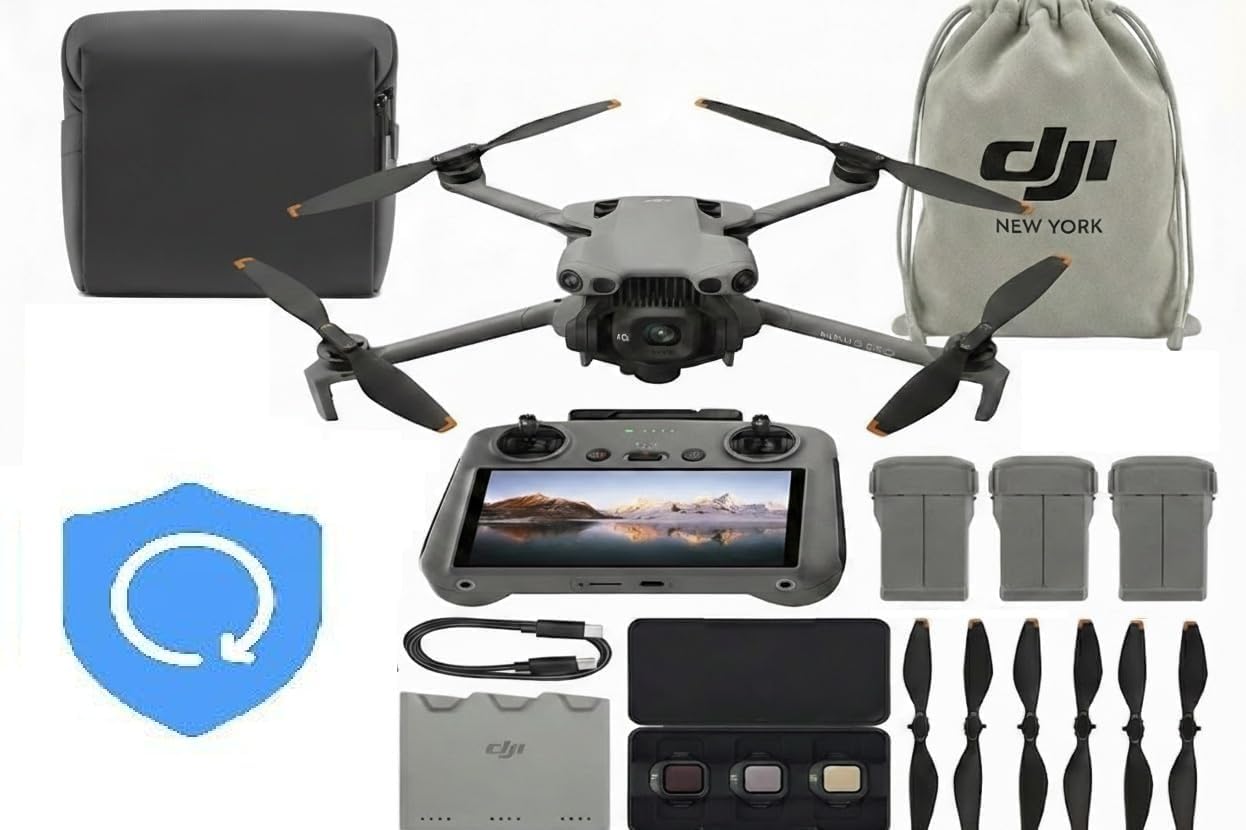
The DJI Mini 5 Pro is the first drone in DJI’s Mini line to carry a 1-inch image sensor — a camera upgrade that was previously reserved for much larger, heavier drones — while staying under 249 grams with its standard battery. This guide covers the Fly More Combo Plus with the DJI RC 2: what the hardware is capable of, what the “Plus” bundle adds over the base kit, where it falls short, and who should look at a cheaper Mini or a bigger Mavic instead.
Who the DJI Mini 5 Pro is for
The Mini 5 Pro is aimed at travel shooters and content creators who want flagship-level image quality without carrying a flagship-sized drone. If you shoot at golden hour, at night, or in high-contrast scenes — and you want footage that grades well and stills that hold up in print or on large screens — the 1-inch sensor is the reason this drone exists. It’s also the natural pick for pilots who want the lightest-touch regulatory treatment: with the standard battery, the drone sits in the sub-249g class in most regions, which keeps paperwork to a minimum.
It’s not aimed at first-time flyers who just want something cheap to learn on, or at professionals who need multiple real focal lengths — those buyers have better options elsewhere, covered below.
The 1-inch 50MP sensor: what it actually gets you
The headline spec is a 50-megapixel, 1-inch CMOS sensor with an f/1.8 aperture, a 24mm-equivalent field of view and an 84° viewing angle. Why should you care about sensor size? A larger sensor gathers more light per pixel, which is what separates clean, detailed footage from noisy, mushy footage when the light gets difficult. In bright daylight the difference between this and a smaller-sensor Mini is subtle. At sunset, in shade, indoors, or at night, the Mini 5 Pro’s larger sensor delivers noticeably cleaner shadows, better dynamic range, and more detail that survives editing.
For stills, you get up to 50MP resolution (8192×6144) with JPEG and RAW capture, so there’s real latitude for cropping and post-processing. If your aerial photography ends up anywhere other than a phone screen — prints, client work, heavy crops — the resolution headroom matters.
Video: 4K/120 slow motion and 10-bit colour
DJI rates the video system at 4K/60fps in HDR with up to 14 stops of dynamic range, plus 4K at up to 120fps for slow motion and Full HD up to 240fps. Recording tops out at a 130 Mbps bitrate in H.264/H.265, and 10-bit D-Log M and HLG colour profiles are available for creators who grade their footage. Low-light sensitivity reaches up to ISO 12,800 (3,200 in the D-Log M and HLG modes).
In practical terms: 4K/120 gives you smooth 4x slow motion at full 4K, which is genuinely useful for action, sports and wildlife clips rather than a gimmick. The 10-bit profiles mean skies and skin tones hold up when you push colours in the edit instead of banding. There’s also a 48mm-equivalent “med-tele” mode that gives you a tighter 2x framing without moving the drone — a sensor-crop zoom, not optical, but handy for compressing a background or keeping distance from a subject.
The 225° gimbal and true vertical shooting
The 3-axis gimbal rotates 225°, including true vertical shooting — native 9:16 portrait video and photos with no cropping. That matters because short-form vertical content (Reels, TikTok, Shorts) is where a huge share of drone footage ends up, and cropping a horizontal frame throws away a large part of that 1-inch sensor’s advantage. Here you get the full sensor working for vertical frames.
Flight time: up to 36 minutes, or 52 with the Plus battery
DJI rates flight time at up to 36 minutes per charge with the standard Intelligent Flight Battery — lab figures, so treat them as best-case, but they’re a meaningful step up from earlier Minis. The Fly More Combo Plus swaps in the Intelligent Flight Battery Plus, which extends DJI’s rated flight time to up to 52 minutes per battery.
There’s a catch worth knowing before you buy: the Plus battery is heavier, and flying with it can push the drone over the 250g threshold in some regions. DJI’s own spec notes advise checking local laws to confirm whether registration or an exam is required when using it. The Plus battery is also not sold in Europe. If staying sub-250g is the whole point of your purchase, the Plus combo’s headline battery figure comes with a regulatory asterisk.
Nightscape obstacle sensing with LiDAR
The Mini 5 Pro carries omnidirectional obstacle sensing — forward, backward, up, down and sideways coverage — combining vision sensors with a forward-facing LiDAR unit and downward infrared sensing. DJI calls this Nightscape obstacle sensing: the LiDAR gives it usable depth perception in low light, and the system can pick out thin obstacles down to roughly a centimetre, like bare branches. That feeds into safer return-to-home behaviour, including at night, plus non-GNSS return-to-home that memorises the flight path when satellite signal is weak, and dual-band GNSS (L1 + L5) for more stable positioning.
The honest framing: this is a safety net, not an autopilot. It makes the drone more forgiving around trees, buildings and wires — especially after dark, where earlier Minis were effectively blind — but it doesn’t replace keeping the drone in visual line of sight or knowing your airspace.
ActiveTrack 360° and intelligent shooting modes
Subject tracking has been upgraded to ActiveTrack 360°, with Standard and Cycling modes plus a night mode, and DJI rates tracking speeds up to 15 m/s in open environments. The cycling mode is tuned for the quick turns and speed changes of bike-mounted action, while the standard mode covers walking, running and vehicles. The usual FocusTrack toolkit — Spotlight, Point of Interest — plus QuickShots and MasterShots are all present for automated cinematic moves.
What this means in practice: if your use case is filming yourself or others in motion — cycling, running, watersports — the Mini 5 Pro follows more reliably and at higher speeds than the tracking on older Minis, which translates to fewer ruined takes.
Transmission, storage and the small upgrades that add up
The O4+ video transmission system is rated for up to 20km in FCC regions (10km under CE) — a lab figure and subject to line-of-sight rules wherever you fly, but the practical takeaway is a more robust, interference-resistant live feed at the ranges most people actually fly. Onboard storage is 42GB, so you’re not grounded if you forget the microSD card, and off-state QuickTransfer over Wi-Fi 6 moves files at up to 100 MB/s without powering the drone on. Other DJI-rated figures: 6,000m maximum takeoff altitude, 12 m/s wind resistance, and an operating range of −10° to 40°C. None of these replace good judgement about weather, but they widen the envelope of where and when you can fly.
What’s in the Fly More Combo Plus with DJI RC 2
This is the bundle this guide is built around. The Fly More Combo Plus (DJI RC 2) includes the Mini 5 Pro, the DJI RC 2 controller with its built-in display — no phone needed to fly — three Intelligent Flight Battery Plus batteries, a two-way charging hub, three pairs of spare propellers, a storage cover, a shoulder bag, a USB-C data cable, and an ND filter set (ND8/32/128).
A few notes on why each piece matters. The RC 2’s built-in screen means faster setup and no drained phone battery; the three Plus batteries plus the hub give you a long day of flying with less downtime (three batteries recharge in about 115 minutes); and the included ND filters are a genuine bonus for videographers — they’re what let you keep the shutter speed cinematic on bright days, and buying them separately adds cost. Compared with the base combo (which pairs the drone with the phone-tethered RC-N3 and a single standard battery), the Plus combo is for pilots who want to fly longer sessions from day one.
Third-party bundles: the 64GB-card listings explained
Some retailers sell this same Mini 5 Pro Fly More Combo Plus as an extended bundle that adds a 64GB memory card (with wallet and reader), a landing pad, and a lens cleaning kit alongside the drone, the DJI RC 2 controller and the batteries. These are reseller-assembled bundles, not DJI’s own box — convenient if you want everything in one order, but check the seller’s reputation and confirm exactly what’s included before paying, since bundle contents vary by listing.
Honest limitations
No drone at this size is without trade-offs:
- Digital zoom only. The 48mm med-tele mode is a sensor crop. If you need real optical reach — compressed landscapes, discreet wildlife work — the Mavic line’s telephoto lenses are in a different league.
- The Plus battery’s weight asterisk. The combo’s 52-minute figure comes with batteries that can push the drone over 250g, which changes your regulatory obligations in some regions. The Plus battery isn’t sold in Europe at all.
- Small drone, real wind. A 12 m/s wind-resistance rating is respectable for 249g, but a sub-250g airframe will always work harder in gusty conditions than a heavier drone. Mountain and coastal flyers should plan around it.
- Availability varies by region. DJI has not launched the Mini 5 Pro in the US, so American buyers are looking at third-party import listings — factor in warranty and support uncertainty before ordering.
- It’s still a premium Mini. You pay a clear premium over the Mini 4 Pro for the 1-inch sensor and LiDAR. If you mostly fly in good daylight and post to social media, the cheaper sibling covers most of that ground.
Who should consider something else
| Drone | Camera | Weight class | Best for |
|---|---|---|---|
| DJI Mini 5 Pro (this guide) | 1-inch 50MP, 4K/120 | Sub-249g (standard battery) | Best image quality in the smallest package; low-light and travel work |
| DJI Mini 4 Pro | 1/1.3-inch 48MP, 4K/100 | Sub-249g | The value pick: still excellent, now cheaper — or keep yours if you already own one |
| DJI Mavic 4 Pro | 100MP tri-camera flagship | ~1,063g (registration required) | Professionals who need three real focal lengths and maximum image quality |
| DJI Neo | 4K UHD, 135g self-flying | 135g | Casual fun and social clips on a small budget — not a camera upgrade |
A note on each alternative. The DJI Mini 4 Pro remains an excellent drone: same sub-249g class, a very capable 1/1.3-inch 48MP camera, full omnidirectional sensing and most of the same intelligent features, at a lower price. Buyers on a budget — or Mini 4 Pro owners who are happy with what they have — don’t need to upgrade urgently; the Mini 5 Pro’s advantages show mainly in low light, slow motion and tracking confidence. The DJI Mavic 4 Pro is the step up for professionals: a 100MP tri-camera system across three focal lengths, but in a ~1,063g airframe that requires registration and a bigger budget. And the DJI Neo is a different animal entirely — a 135g palm-sized self-flying drone for casual follow-me clips and social fun, much cheaper, but no substitute if image quality is the goal.
The sub-249g rule: what it means where you fly
With the standard battery the Mini 5 Pro weighs 249.9g (±4g), keeping it in the lightest regulatory class in most regions — and it carries EU C0 certification. What that buys you in practice: in the US, sub-250g drones flown recreationally are generally exempt from FAA registration; in the EU, C0 puts it in the A1 subcategory with the fewest operational restrictions; in the UK you’ll still need a Flyer ID and Operator ID and must follow the Drone Code. Rules differ by country and change, so confirm your local requirements before flying — and remember the Plus battery can move you into a heavier class.
Buying considerations
Choose the combo that matches how you’ll actually fly. The base kit (RC-N3 controller, one standard battery) suits occasional flyers who don’t mind tethering a phone. The Fly More Combo (RC 2) adds the built-in-screen controller, extra standard batteries and the hub. The Fly More Combo Plus covered here is the maximum-endurance option — three Plus batteries, ND filters and the bag — best for creators who shoot long sessions and want everything in one box.
Availability is the other thing to check. DJI has not launched the Mini 5 Pro in the US, so listings aimed at American buyers are third-party imports — confirm the seller, the warranty terms and the returns policy before ordering. Wherever you buy, compare what’s actually in the box against DJI’s official combo contents, since reseller bundles add (and sometimes substitute) accessories.
Bottom line
The DJI Mini 5 Pro is the most camera you can currently put in the air under 249 grams: a 1-inch 50MP sensor, 4K/120 slow motion, 10-bit colour, night-capable LiDAR obstacle sensing and up to 36 minutes per battery (52 with the Plus cells). For travel shooters and creators who care about low-light quality, it’s the clear pick in the Mini line — and the Fly More Combo Plus with the DJI RC 2 is the most complete way to buy it, provided the Plus battery’s weight trade-off works for where you fly. Budget buyers and happy Mini 4 Pro owners can save their money; professionals who need real telephoto reach should look at the Mavic line instead.
Disclosure: As an Amazon Associate, we earn from qualifying purchases.
Check the DJI Mini 5 Pro Fly More Combo Plus with DJI RC 2 on Amazon
