


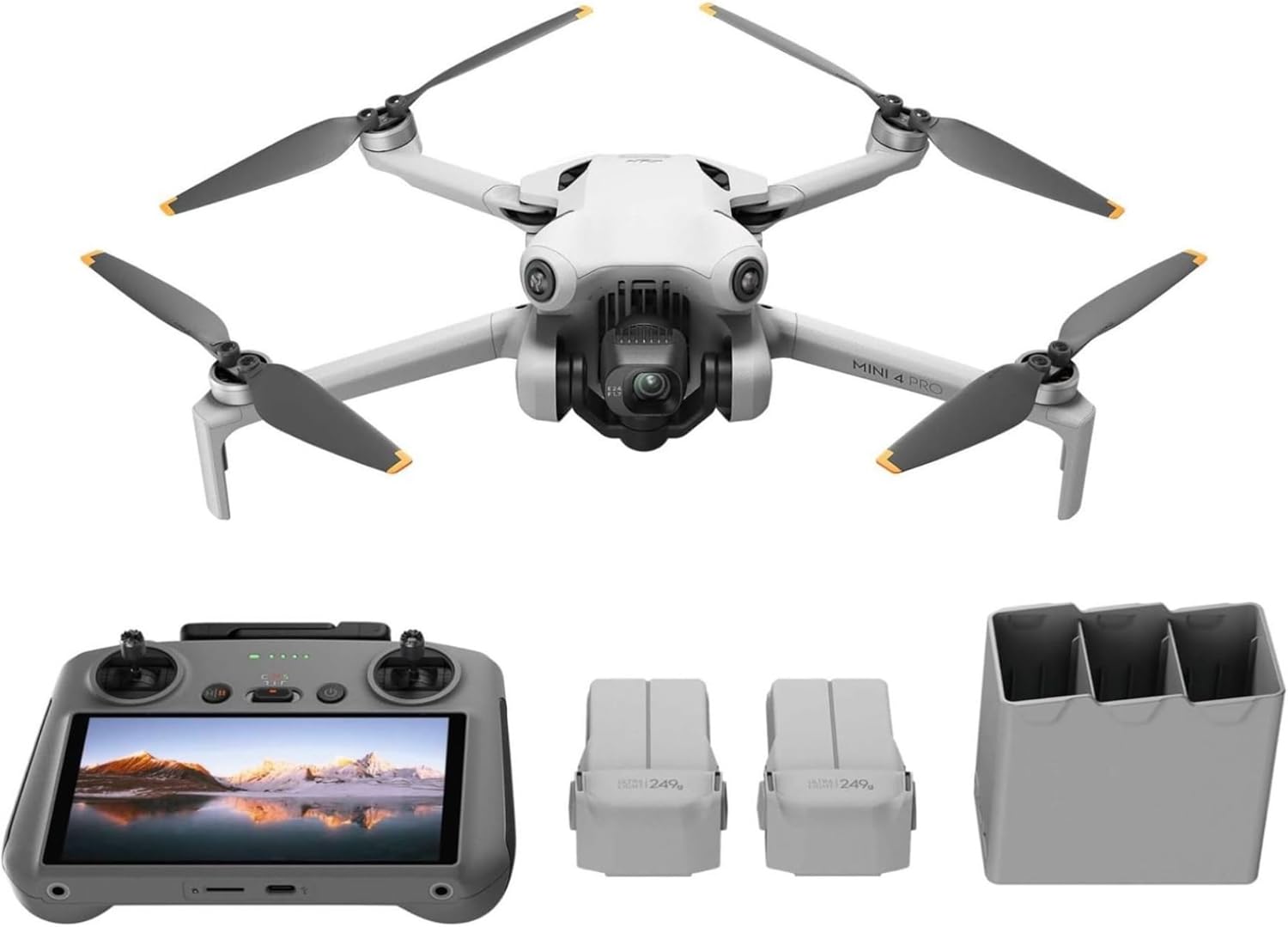
The DJI Mini 4 Pro is the drone that made “sub-249g” feel like a full-featured choice rather than a compromise. Launched in late 2023, it brought omnidirectional obstacle sensing, ActiveTrack 360°, 4K/100 slow motion, and DJI’s O4 transmission down to the lightest regulatory weight class — and it has stayed DJI’s most popular creator drone ever since. If you shoot travel content, real estate, or social video and want something you can toss in a jacket pocket, this is the drone most people mean when they say “get a Mini.”
This guide breaks down who the Mini 4 Pro Fly More Combo (DJI RC 2) is actually for, what the bundle adds over the base drone, what the key specs mean in practice, the honest limitations nobody puts on the box, and where it sits against the DJI Mini 5 Pro and DJI Mavic 4 Pro — so you can decide whether to buy it, or step up or down the lineup.
Who the Mini 4 Pro Fly More Combo is for
The Mini 4 Pro is built for creators who travel light. Travel vloggers, real-estate shooters doing quick exterior work, wedding photographers grabbing establishing shots, and social-media creators who need a drone that deploys in under a minute. Under 249 g it slips into a camera bag’s side pocket, and the RC 2 controller’s built-in screen means no phone mount, no cable, no draining your phone battery in the field.
It’s also the sensible pick for pilots who want real safety nets without paperwork headaches: omnidirectional obstacle sensing and ActiveTrack 360° make it one of the most forgiving DJI drones ever sold at this weight. If you’re moving up from a toy drone or a basic Mini, this is the jump where flying starts to feel automatic.
What the Fly More Combo (DJI RC 2) adds over the base drone
DJI sells the Mini 4 Pro in several configurations. The base package pairs the drone with the RC-N2 controller (the one that holds your phone) and a single Intelligent Flight Battery. The Fly More Combo with DJI RC 2 — the configuration this post covers — changes three things that matter for real shooting:
- DJI RC 2 instead of RC-N2. The RC 2 has a built-in display, so you skip the phone-tethering ritual entirely. Faster setup, brighter screen than most phones in sunlight, and your phone stays charged.
- Three batteries instead of one. With each standard battery rated at up to 34 minutes of flight time (DJI’s lab figure), three batteries give you a combined ~102 minutes of flight — the difference between getting the shot and packing up because a battery is cooking on a hub.
- A two-way charging hub. Charges up to three batteries in sequence, and can work in reverse — the hub can use battery power to charge your phone or controller via USB. DJI also includes a shoulder bag, three spare propeller pairs, screws, a screwdriver, gimbal protector, propeller holder, and both USB-C and USB-C PD cables (based on the official DJI SKU’s published box list).
One caution when shopping: many Amazon listings bundle the official Fly More Combo with reseller-added extras — 128GB memory cards, card readers, backpacks, landing pads, cleaning kits, even extended warranties. Those aren’t part of DJI’s box; they’re added by the seller. Check the listing’s “what’s included” section so you know exactly which extras are reseller add-ons versus the standard DJI package.
The camera: what a 1/1.3-inch sensor gets you
The Mini 4 Pro’s camera is a 48MP 1/1.3-inch CMOS sensor behind an f/1.7 lens with a 24mm-equivalent focal length and an 82.1° field of view. Translated out of spec-sheet language:
- 4K/60fps HDR is the workhorse mode — sharp, stabilized, with HDR smoothing out the sky-to-shadow contrast that kills drone footage at midday.
- 4K/100fps slow motion gives you genuine 2.5x slow-mo at full 4K, which is rare at this weight and price. Great for action, waves, sports.
- True Vertical Shooting rotates the camera to native 9:16, so Reels, TikTok, and Shorts come out of the drone ready to post — no cropping a horizontal frame and throwing away resolution.
- 10-bit D-Log M and HLG color profiles give you grading headroom that a basic 8-bit drone simply doesn’t have. If you color-grade your footage, this is the feature that keeps the Mini 4 Pro relevant.
- 48MP stills (JPEG + RAW) are genuinely useful for prints and crops, and Night Shots mode cleans up low-light stills noticeably versus older Minis.
The honest context: a 1/1.3-inch sensor is excellent for a sub-249g drone, but physics is physics. In harsh midday contrast or at dusk, a larger-sensor drone — like the Mini 5 Pro’s 1-inch sensor — pulls ahead on dynamic range and noise. The Mini 4 Pro’s footage is superb for YouTube, client work, and social; it’s not the tool for pixel-peeping 4K masters.
Obstacle sensing and intelligent flight: a real safety net
This is the Mini 4 Pro’s biggest generational leap. Where the Mini 3 Pro had tri-directional sensing, the Mini 4 Pro senses in all directions — forward, backward, sideways, upward, and downward — using vision sensors plus a 3D infrared system. DJI’s APAS (Advanced Pilot Assistance System) uses that data to route around obstacles automatically instead of just stopping.
What that means in practice: ActiveTrack 360° can follow a subject on complex paths with the drone steering itself around trees and structures; Waypoint Flight lets you pre-plan repeatable routes for real-estate or progress documentation; and MasterShots, QuickShots, Hyperlapse, and Cruise Control automate the cinematic moves that take beginners months to learn manually. It’s not a substitute for keeping visual line of sight — no sensing system is — but it’s the most capable safety suite DJI has ever put under 249 g.
Flight time, transmission, and the numbers that matter
- Flight time: up to 34 minutes with the standard Intelligent Flight Battery, or up to 45 minutes with the optional Intelligent Flight Battery Plus. Treat both as DJI’s lab figures — wind, cold, and aggressive flying all take their cut in the real world.
- Transmission: DJI O4, rated up to 20 km (FCC) with a 1080p/60 live feed. That figure assumes ideal, interference-free, line-of-sight conditions; in towns and suburbs, expect far less. Still, it’s a big step up from the Mini 3 Pro’s 10 km O2 link.
- Speed: up to 16 m/s (about 57.6 km/h) in Sport mode.
- Wind resistance: rated to Level 5 (up to 10.7 m/s). The light airframe still gets pushed around more than a heavier drone, but it holds its own on breezy coastal shoots.
- Positioning: GPS + Galileo + BeiDou for a fast, solid satellite lock; 4 km max takeoff altitude; operating range of −10°C to 40°C.
- Storage: 2 GB of internal storage — effectively nothing. A microSD card is mandatory, not optional.
The sub-249g advantage — and the Plus-battery asterisk
Under 249 g is the regulatory sweet spot. In the US, recreational flyers don’t need FAA registration below 250 g; in the EU and UK, the lightest category carries the fewest restrictions. The Mini 4 Pro was designed to live exactly here — that’s why it weighs in at 249 g with the standard battery, not 251.
The asterisk: the Intelligent Flight Battery Plus pushes the drone over 250 g, which can pull it into registration requirements (DJI’s own reseller materials note FAA registration may be required with the Plus battery). If you bought the drone specifically to stay under the limit, treat the Plus battery as a separate decision with its own paperwork. Also note DJI’s own firmware note: Remote ID behaviour is tied to the battery in use, so check your local Remote ID rules either way.
Honest limitations: who should NOT buy the Mini 4 Pro
- Image-quality maximizers. If low-light performance and dynamic range are your top priority and your budget stretches, the Mini 5 Pro’s 1-inch 50MP sensor is a genuine step up, not a marginal one.
- Professionals who need reach or 6K. No telephoto lens, no optical zoom — the 24mm fixed lens means digital zoom only. If you need the 70mm/168mm telephoto perspectives or 6K capture, that’s Mavic 4 Pro territory.
- Casual selfie flyers. If you mostly want a drone that follows you around on hikes, the 135g DJI Neo is cheaper, simpler, and launches from your palm.
- Strict budgets. The Mini 4 Pro sits in the mid-premium tier. If the price stings, the older Mini 3 Pro is still sold at a reduced price and covers the basics well.
- Wind-warriors and heavy-lift users. It’s a 249 g aircraft; it can’t carry accessories and it won’t shrug off conditions the way a 1 kg Mavic will.
Mini 4 Pro vs Mini 5 Pro: should you step up?
The Mini 5 Pro is the Mini 4 Pro’s successor and the current flagship of the Mini line. The headline difference is the camera: a 1-inch 50MP sensor with an f/1.8 lens, 4K/60 HDR with 14 stops of dynamic range, and up to 36 minutes of flight time on the standard battery (52 with the Plus). It also adds a 225° rotating gimbal with true vertical shooting and forward LiDAR for its obstacle sensing.
Step up to the Mini 5 Pro if image quality is the deciding factor — dusk, dawn, and high-contrast scenes are where the 1-inch sensor earns its premium — or if you want the longest flight times in the class. Stay with the Mini 4 Pro if the price gap is significant and you shoot mostly in good light: you still get omnidirectional sensing, ActiveTrack 360°, 4K/100 slow-mo, and the same sub-249g freedom. For many creators, the Mini 4 Pro is the value sweet spot of the entire DJI lineup right now.
Read the full breakdown: DJI Mini 5 Pro: Who It’s For, What the 1-Inch Sensor Gets You, and Whether the Fly More Combo Plus Is Worth It.
Mini 4 Pro vs Mavic 4 Pro: should you step up?
The Mavic 4 Pro is a different animal: a ~1,063 g flagship with a 100MP 4/3-inch Hasselblad main camera, two telephoto cameras (70mm and 168mm), 6K/60 HDR video, and up to 51 minutes of flight time. It needs FAA registration in the US, carries heavier EU/UK obligations, and costs roughly three times what a Mini 4 Pro combo does.
Step up to the Mavic 4 Pro if you’re doing paid work where the camera is the product — the 4/3-inch sensor and telephoto pair produce footage the Mini line physically cannot match. Stay with the Mini 4 Pro if you travel, fly recreationally, or hate paperwork: it’s a fraction of the weight, needs no registration for recreational use, and fits in a jacket pocket. Most creators don’t need the Mavic; the ones who do already know it.
Read the full breakdown: DJI Mavic 4 Pro: Who It’s For, What the Tri-Camera Gets You, and Whether It’s Worth It.
Buying guide: which Mini 4 Pro combo to get
- Base (RC-N2, 1 battery): the cheapest way in. Fine if you already own DJI batteries or only fly short sessions — but one battery gets old fast.
- Fly More Combo (RC-N2, 3 batteries): the value pick if you don’t mind using your phone as the display. Same three batteries and hub as the RC 2 version.
- Fly More Combo (DJI RC 2, 3 batteries): the configuration covered here, and the one we’d recommend for most creators. The built-in screen transforms the daily experience: no mounts, no cables, no phone battery anxiety.
- Fly More Combo Plus variants: swap the standard batteries for Plus batteries (up to 45 min each). Only worth it if you genuinely need the endurance — remember the over-250g asterisk and check your local registration rules first.
Compatibility notes: the Mini 4 Pro works with the DJI RC 2 and RC-N2 controllers and the DJI Fly app. It does not use the older RC-N1. If you’re buying used batteries or accessories, confirm they’re Mini 4 Pro / Mini 3-series compatible — the Plus batteries are physically larger and change the drone’s weight class.
Quick comparison
| Drone | Camera | Weight class | Best for |
|---|---|---|---|
| DJI Mini 4 Pro | 1/1.3″ 48MP, 4K/60 HDR, 4K/100 | Sub-249g | Travel creators; the value sweet spot |
| DJI Mini 5 Pro | 1″ 50MP, 4K/60 HDR (14 stops) | Sub-249g (standard battery) | Best image quality under 249g |
| DJI Mavic 4 Pro | 4/3″ 100MP Hasselblad + 2 telephotos | ~1,063g (registration required) | Professional paid work |
| DJI Neo | 4K UHD, fixed basics | 135g | Casual follow-me and selfie flights |
The verdict
The DJI Mini 4 Pro Fly More Combo with DJI RC 2 remains the most balanced creator drone DJI sells: a genuinely capable 48MP 4K/60 HDR camera, omnidirectional sensing, 102 minutes of combined flight across three batteries, and a controller with its own screen — all under 249 g, with no recreational registration required in the US. The Mini 5 Pro beats it on image quality and the Mavic 4 Pro beats it on everything except portability and price, but neither matches the Mini 4 Pro’s ratio of capability to cost and convenience. If you want one drone that handles travel, client work, and social content without dominating your bag or your paperwork, this is it.
Disclosure: As an Amazon Associate, we earn from qualifying purchases.
Check the DJI Mini 4 Pro Fly More Combo (DJI RC 2) on Amazon
